

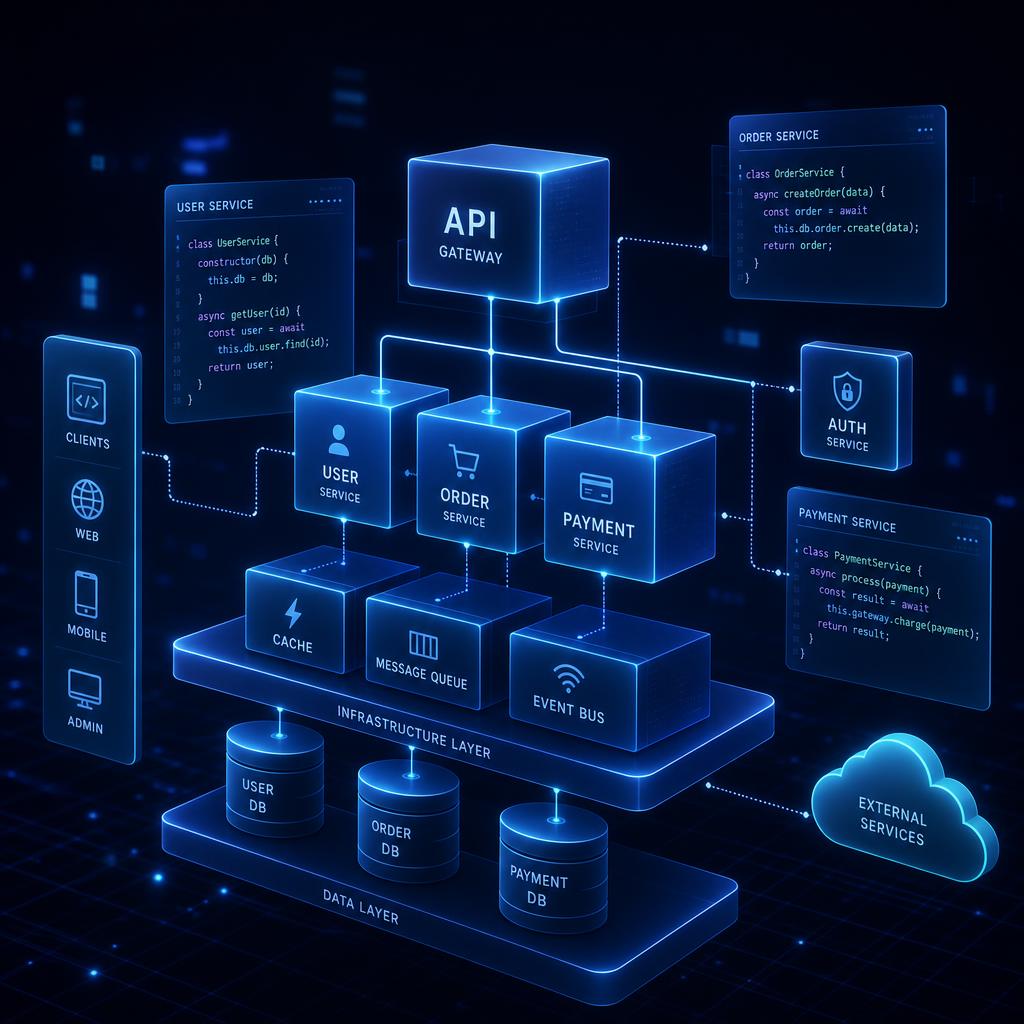
Microservices Architecture
Independently deployable, event-driven services designed for scalability, resilience, and autonomous team ownership.
Microservices Architecture is the design of systems as a set of small, independently deployable services organized around business capabilities. NexWEB Technologies defines clean service boundaries, establishes event-driven communication, and builds the platform concerns like observability, resilience, and deployment that make distributed systems dependable. We apply this pattern deliberately, only where it genuinely improves scalability and team autonomy over a well-structured monolith. The outcome is a system that teams can evolve, scale, and deploy independently without fragile coupling.
The Challenge
Enterprises frequently face severe operational and technical blockers when trying to scale or modernize in this domain. Typical issues include:
- Monoliths where one change forces a full redeploy
- Teams blocked by tight coupling and shared release cycles
- Components that cannot scale independently under load
What We Deliver
Service Boundary Design
Decomposing systems around business capabilities with clear ownership and contracts.
Event-Driven Communication
Using asynchronous messaging so services stay loosely coupled and resilient.
Platform & Observability
Providing deployment, tracing, and resilience patterns that keep distributed systems dependable.
Industry Use Cases
Retail & E-commerce
Independently scalable checkout, catalog, and inventory services that handle demand spikes gracefully.
Financial Services
Decoupled payment and ledger services with event streams for auditability and resilience.
Healthcare
Capability-aligned services letting teams evolve scheduling and records independently.
Our Approach
Domain Decomposition
We identify business capabilities and define service boundaries that minimize cross-service coupling.
Communication & Data
We choose sync versus async patterns and data ownership per service to avoid distributed monoliths.
Platform Foundations
We stand up CI/CD, observability, and resilience patterns before scaling out many services.
Incremental Rollout
We extract and deploy services gradually, validating operability before broadening the estate.
Why NexWEB Technologies
- Deliberate use of microservices only where they beat a solid monolith.
- Boundaries drawn around business capabilities, not technical layers.
- Platform foundations built first so distributed systems stay operable.
Frequently Asked Questions
Do we actually need microservices?
How do you decide where service boundaries go?
How do services communicate reliably?
How do you keep a distributed system operable?
Can we migrate from a monolith gradually?
Technologies Used
Ideal For
Organizations scaling systems and teams that need independent deployment and resilience.
Ready to execute?
Discuss your projectReady to modernize your mission-critical platforms?
Partner with NexWEB Technologies to securely implement enterprise AI, scale your cloud infrastructure, and build the software that runs your business.